A word of caution: Substack alerted me the article is too long for email (over 7,000 words). I guess I got a bit technical and overzealous with details. So, if it is truncated in your email, readers can read it on Substack website or app, if it intrigues you. Thanks.
In my last article, I detailed the battlefield damage Iran has inflicted upon the US during the first month of the war.
The scale and scope of high-value asset losses by the US is astonishing, in contrast to the “victory” narrative spun by the Trump regime.
The depletion of its offensive and defensive munitions is unprecedented, especially since this is merely a “medium intensity” conflict in the grand scheme of things.
Although Iran is the most technically sophisticated adversary the US has fought directly since the Cold War, the country is a middling power suffocated by decades of sanctions.
For illustration, Iran’s 2025 GDP and defence budget were $356 billion and ~$9 billion. In comparison, Singapore’s 2025 GDP and defence budget is $604 billion and $17 billion.
Iran doesn’t have a real air force or navy. It doesn’t have a modern integrated air defense network (IADN) or significant space assets.
Iran’s battlefield achievements are the result of asymmetrical warfare with low-cost drones and short-range ballistic missiles.
These are clear indications that the US is militarily incapable to have a “great power” war with its dated technologies, low magazine depth, and high-cost low-density weaponry, which I’ll dive into in detail.
To support this conclusion, in the second part of my article, I’ll discuss the military lessons from the Iran war.
Then, I will dissect the US weapon platforms and show that China has already reached technical parity or lead in most major categories.
Furthermore, China has moved away from the traditional platform-centric combat doctrine of the US military to a new system-of-systems doctrine.
The new doctrine emphasizes high-attrition, high-tech, low-cost unmanned systems powered by artificial intelligence to complement high-value manned platforms.
The doctrine is supported by deep supply chains, civil-military fusion, superior industrial scale, and surge capacity that are lacking in the US’s private, profit-driven, just-in-time boutique military industrial complex.
Military lessons from the Iran war
Iran clearly understands that its limited air defenses make it hard to prevent aerial bombardment.
So Iranian forces have focused on inflicting reciprocal damages to US and Israeli assets rather than avoiding the blows.
On Feb 28, the first day of the war, Iran neutralized the US ability to “see” and control the battlefield by using drone swarms and hypersonic missiles to take out the US ground-based strategic early warning radar (SEWR) (AN/FPS-132 Block 5) at the Al Udeid Air Base in Qatar.
On March 17, an Iranian Shahed-136 kamikaze drone directly hit the radome and phased array antenna of an AN/FPS-117 long-range early warning radar in the Al-Qaysumah Airport in Saudi Arabia.
On March 20, Iran used drone swarm and low-flying cruise missiles to exhaust the interceptors of the THAAD system in Prince Sultan Air Base in Saudi Arabia, then followed with a Fattah-2 hypersonic missile strike to destroy the THAAD.
On March 23, a Shahed-136 and Fattah-2 joint strike took out another AN/FPS-117 radar in the Rafha Region of Saudi Arabia.
The destruction of the long-range early warning radars and THAAD batteries resulted in a gap in US mid/long-range air defense.
This exposed terminal-phase defense platforms such as Patriot to Iranian attacks.
A Patriot system can track over 100 targets at the same time but can only guide 18 interceptors simultaneously, opening a window for swarming drones and missiles too numerous to be shot down in one engagement.
Other drones/missiles were able to penetrate its defense during reloading, destroying the Patriot platform which cost over $1 billion.
At least 3 Patriot batteries were destroyed in the UAE, Qatar, and Saudi Arabia.
Losses of Patriots led to gaps in terminal defense for key assets and air bases, resulting in Iranian destruction of one E-3 Sentry AWACS and at least 5 KC-135 Stratotanker refuelling planes on the airfield tarmacs in Saudi Arabia.
This, in turn, led to a lower sortie rate of combat jets.
Iran’s successful implementation of coordinated drone swarm and ballistic missile attacks created a flywheel of cascading impact on US defenses.
- By destroying these critical air defense nodes, Iran “blinded” US defense and reduced the interception rate of Iran’s missiles
- By weakening the US’s ability to “see” and “intercept”, Iran paved the way for its drones and missiles to eliminate high-value assets such as the E-3 AWACS and the KC-135 tankers
- Without such “force multipliers”, the US ability to generate sortie into the Iranian airspace is truncated
In addition, the threat of Iran’s anti-ship missiles has pushed the USS Lincoln carrier to retreat over 1,000 km away from the Persian Gulf.
As a result, carrier-based air sorties were also reduced as the average “strike reach” of Lincoln’s air wing is only 450 to 600 nautical miles.
Lincoln’s primary combat jets are F-35C Lightning II, whose max combat radius is approximately 600 nm, and F/A-18E/F Super Hornet with a combat radius of about 390 to 450 nm. Neither can carry out missions inside Iran without air refueling.
Saturation attacks by drones and missiles have also disabled all 13 US bases in the Gulf, rendering them uninhabitable.
This forced the ~50,000 US personnel stationed in the region to hide in civilian buildings and stay in civilian hotels, which were defenceless and further targeted by Iran.
Iran has proven low-cost and mass-produced weapons can effectively overwhelm the most expensive air defenses.
Joseph Stalin said, “Quantity has a quality of its own”. This stands true 80 years later.
In fact, the US itself was a model of using overwhelming industrial capacity to arm itself and its allies in WW2 to defeat the technically superior Germans.
Another lesson from Iran is that innovative low-tech solution can be used to defeat expensive high-tech platforms.
On March 19, Iran used its indigenous 358 missile (also known as the SA-67) to shoot down a F-35A stealth fighter over central Iran.
CENTCOM confirmed the jet was damaged but claimed the pilot was safe and the wounded F-35A landed in Kuwait.
This marked the first combat shoot-down of the vaunted F-35 stealth fighter, which carries the dubious honor of “history’s most expensive weapon system” – some $2 trillion according to US Congressional Budget Office.
The 358 missile is an inexpensive “loitering surface-to-air missile” (costing $30,000 to $90,000) – a hybrid between a drone and a traditional missile, similar to China’s ASN-301 anti-radiation drone/missile (more on this later).
Iran used passive tracking rather than traditional active radar to bypass F-35’s stealth.
Stealth aircraft are designed to be invisible to radar, but they still produce significant heat from their engines visible to infrared detection.
Iran used passive infrared sensors to track the jet’s heat signature without alerting the pilot’s radar warning receivers.
A 358 loitering drone/missile was launched into the combat zone, flied slowly, waited for its optical and infrared sensors to detect the F-35’s thermal signature, and then launched a “silent attack”.
Unlike standard anti-aircraft missiles that flies directly to its target at Mach 2 or 3, the 358 flies at subsonic speed with a micro-turbojet engine.
It uses infrared (IR) and optical sensors to find its target. Because it does not emit a radar signal, it is “silent” – it doesn’t trigger the Radar Warning Receivers (RWR) on aircraft like the F-35.
While the 358’s slow speed makes it less effective against a pilot who is actively performing high-G evasive maneuvers, its passive nature means many targets don’t realize they are being hunted until it is too late.
The 358 missile can also be used in combination with traditional short-range missiles such as the Majid and serves as a low-cost threat to high-value ariel targets such as F-35 ($80 to 100 mil) or MQ-9 Reaper ($30 mil).
The 358 is responsible for taking down most of the 24 MQ-9 Reapers the US lost so far.
Despite Trump and Hegseth’s fake assurance of “air dominance” over Iran, the Iranian airspace is hardly safe for even the most advanced US jets, forcing them to consume expensive stand-off munitions.
And the threat is posed by weapons that cost a small fraction of the US jets and missiles.
Iran has imposed a disproportionate cost exchange ratio on the US through asymmetrical warfare.
Obviously the American military industrial complex is eager to hide this from the public at home and its potential buyers in other countries.
Iran can achieve such cost advantages because it utilizes a civilian supply chain to produce its weapons. Iran doesn’t have to access military supply chains that are under US sanctions.
The Shahed-136 uses civilian motors, runs on standard gasoline instead of aviation fuel. It uses composite materials for air frame, a wooden propeller, and civilian Beidou GNSS guidance.
Shahed-136 exploits blind spots of advanced US air defense systems designed for intercepting sophisticated ballistic missiles and fighters.
It flies low, slows, and has a tiny radar cross section (RCS). Modern air defense is not designed to deal with such threats. Even upon detection, the cost of the US interceptors could be as high as 100 times or more over the $30,000 drones.
Iran War is also showing that modern wars are moving away from technological superiority to industrial capacity.
For example, thousand-dollar drones are deployed in the thousands while million-dollar interceptors can only be made in the dozens. Their respective production cycles are measured in days vs. months, even years.
The high-cost low-density long-lead-time weapon platforms deployed by the US military, at great profit for Lockheed Martin, Boeing, and RTX, are fragile against saturation attacks such as drone swarms and missile salvos.
In addition to “quantity is a quality of its own”, cost asymmetry is a weapon in itself.
Facing with swarms of cheap weaponry, interception success rate is irrelevant. When a $4 mil Patriot PAC-3 interceptor is used to shoot down a $30,000 drone, the shooter loses regardless.
China has long appreciated the importance of cost asymmetry and the value of mass/quantity in modern warfare.
Norinco, a major defense contractor, has mass produced and exported Feilong-300D drone at $10,000, which has a range of 1,000 – 2,000 km and a speed of 220 km/h with a delta-wing configuration and a piston engine, similar to the Shahed-136.
Hundreds of Feilong-300D can be used in a single, AI-powered swarm attack.
Another example is the YKJ-1000 hypersonic missile (Mach 5 to Mach 7) made by Beijing-based private space firm Linkong Tianxing.
It is priced at $99,000, the same price as a US JDAM-LR, which is basically a dumb gravity bomb strapped with a guidance kit and dropped by planes flying overhead.
YKJ-1000 has a range of up to 1,300 km and can be launched from standard commercial shipping containers, allowing it to be concealed in civilian trucks or ships.
YKJ-1000 is nicknamed “cement missile” because it uses non-traditional, civilian-grade materials—including foamed concrete—as a heat coating to survive the extreme temperatures of hypersonic flight.
It uses automotive-grade chips, mass-market drone optics, and die-cast structural parts to slash costs.
Lingkong-Tianxing is also developing an AI-enabled swarm version of the YKJ-1000.
While the basic YKJ-1000 focuses on low-cost mass production, this new variant aims to transform the missile from a “blind” projectile into a cooperative hunter.
It uses embedded machine learning algorithms to achieve autonomous target selection, cluster collaboration, and adaptive evasive maneuvers.
Much of this AI logic is adapted from China’s dominant commercial drone industry, using mass-market chipsets and power-management components that are significantly cheaper than bespoke military hardware.
YKJ-1000 is much less sophisticated than the mainstream Chinese hypersonic missiles such as DF-17, DF-21D, DF-27, JY-19, YJ-20, and CJ-1000, state-of-the-art products of the public defense sector.
However, its extremely low cost makes the YKL-1000 perfect candidate for saturation attacks and as strategic decoys to exhaust enemy air defense interceptors before the high-end arsenal delivers the final punch.
Read more about YKL-1000 here. https://interestingengineering.com/military/chinas-cement-coated-hypersonic-missile
China leads the world in hypersonic missiles both in technological sophistication and cost efficiency. We’ll discuss it more later in the article.
Analysis of US weapon platforms
In my last week’s article, I pointed out the US has taken the best weapons in its entire conventional arsenal to the Iran war.
This includes attack platforms including the USS Gerald Ford carrier strike group, F-22 and F-35 stealth fighters, F-15E Strike Eagle, F/A-18 Super Hornet, A-10 Warthog, B-2 and B-52 bombers, E-3 Sentry AWACS, KC-135 tanker, MQ-4C Triton and MQ-9 Reaper drones, and more.
The US military has also deployed its most advanced defence systems including ground-based THAAD and Patriot, and ship-borne Aegis systems.
In terms of firepower, the US has deployed all primary precision stand-off munitions in its offensive and defensive arsenal including Tomahawk, JASSM-ER, SM-3/SM-6 interceptors, THAAD and Patriot PAC-3 interceptors, HIMARS-launched ATACMS, and the very latest long-range Precision Strike Missiles (PrSM).
To adapt to the new world of low-cost suicide drones, the US has developed and deployed a copycat of the Shahed-136, named LUCAS.
While these weapons delivered massive firepower over an adversary with limited air defense, there are multiple vulnerabilities.
The most noticeable vulnerability is the low-density and low magazine depth, meaning the US simply doesn’t have enough hardware to prosecute the war, even a medium-intensity one, beyond a few weeks. https://militarywatchmagazine.com/article/us-extreme-depletion-missile-stockpiles-iran
Every loss of key weapons and munitions will take months, even years, to replenish and replace. This makes the US military essentially a force that punches hard at first but without no stamina or resilience.
In boxing, such players are called “glass cannons”. They are known for having tremendous early punches but poor staying power.
The most prominent examples include Earnie Shavers and Julian Jackson. Both are famous for being hard punchers who can “dish out” but cannot take a long fight.
Muhammad Ali was the very opposite, who could “dance” around for 15 rounds without slowing down with endless stamina and win matches in late rounds.
What is the record for Ali? And who remember Shavers or Jackson?
The US military has turned into a “glass cannon” power.
And it is irreversible. Because the current platform-centric weapon procurement system benefits the private profit-driven and politically powerful military industrial complex.
The US solution to this vulnerability is not to innovate and build low-cost and massed modern weaponry, but rather to double down on buying more of the same.
The $1.5 trillion war budget proposed by the Trump regime is an affirmation of that corrupt system.
Another less talked-about aspect of the exposed US vulnerabilities in the Iran War is the outdated technology and weapons the US military still relies on today.
Many primary weapons used in the war, still considered the best in the US arsenal, were actually developed decades ago in the Cold War.
They are limited, by definition, by the technologies of the time, especially in sensor, radar, and data links.
They also suffer from wear and tear of decades-long high-frequency deployments, maintenance deficits, and astronomical operating costs as parts & components are often no longer produced.
The KC-135 Stratotanker took first flight in 1956 and most of the tankers flying today have airframes over 60 years old. Production has long stopped and maintenance is done through cannibalization of older planes kept in boneyards.
A-10 Warthog took first flight in 1972, designed to take on Soviet Red Army tanks in western Europe with a cannon gun. The jet flies low and slow with no survivability against modern air defense system, even basic MANPADs (man-portable-air-defense systems).
It was scheduled for retirement by 2026, but the USAF announced this week it will extend the service to 2030 as there is no ready replacements.
The F-15 Strike Eagle took first flight also in 1972, created for “air superiority” after the Vietnam War. The fighter has a lot of raw power as a heavy twin-engine jet but suffers from antiquated radar, sensor fusion, and networking.
The Tomahawk cruise missile was developed in the 70s and entered service in 1983. The latest Block V versions being fired today have to squeeze modern electronics into a 1970s-designed frame.
Patriot air defense missile was developed in the 1960s. Although it is constantly upgraded (PAC-3 is the latest version), it suffers from “physical ceiling” of the original hardware – the airframe, power systems, internal cooling, and data bus were never built for 21st century technology.
The 1970s design philosophy for the Patriot was to fly “near” a target and explode (“Blast-Fragment”). However, to stop a modern hardened ballistic missile, you need to hit it directly (“Hit-to-Kill”), which is beyond Patriot interceptors.
E-3 Sentry AWACS entered service first in 1977, and production also long stopped. Still highly valued as the primary Air Battle Manager (ABM) of the USAF, the E-3 is incredibly expensive to maintain, and its 50-old airframe is long scheduled for retirement by now.
However, the E-3 Sentry’s successor – the E-7 Wedgetail – won’t be ready for at least 2 to 3 years. If it arrives at all. Read here how Pentagon left E-7 out of the 2027 budget. https://www.airandspaceforces.com/pentagon-leaves-e-7-out-of-budget-2027/
The US had a total fleet of 16 E-3 Sentry with only 7 or 8 in operational condition before the war. One was lost on the tarmac of the Prince Sultan Air Base after being struck on an Iranian drone. The loss cannot be replaced.
The E-3 destruction in Saudi Arabia shows that even if these aircraft stay far back, they are vulnerable on the ground to hypersonic missile and drone strikes.
Comparing with China
One main challenge in any Pacific conflict is the “tyranny of distance.” To provide meaningful command and control, a US AWACS must fly close enough to the front lines to detect China’s low-observable threats like the J-20 or GJ-11.
However, China’s development of “AWACS-killer” missiles, such as the 400 km PL-17 and the 6,000 km scramjet-powered CJ-1000, has created a “no-go zone” that extends thousands of kilometers.
On the other hand, China’s AWACS, including KJ-3000, KJ-700, and KJ-600, can safely operate within the A2AD bubble protected by a fully integrated air defense network (IADN).
The network includes land- and ship-based mid/long-range defence interceptors (HQ-29, HQ-19, HQ-9B, HHQ-9) and terminal defence (HQ-11, HQ-20, Bullet Curtain barrage gun, and Hurricane-3000 anti-drone microwave weapon).
Norinco has developed two world-first anti drone swarm weapons
Feb 10
Drones are heralding a new era of warfare in the Ukraine battlefield. As much as 70% of all casualties are reportedly caused by drones.
Since the US has long relied on stealth as the “tip of the spear” to establish air superiority, China has built an anti-stealth network of radars.
China has moved beyond single-radar detection to a distributed sensor fusion model that combines multiple specialized technologies into a unified “kill web”.
This system includes –
1. Meter-Wave & ultra-high frequency (UHF) “Stealth Killers”
Long-wavelength radars that can bypass the geometric shaping of stealth aircraft like the F-22 and F-35.
- JY-27V: A mobile meter-wave AESA radar unveiled at the 11th World Radar Expo in 2025. It is designed to detect stealth targets at long ranges and can be deployed in under 10 minutes.
- YLC-8E: Often called the “flagship” of Chinese anti-stealth radar, it operates on UHF bands and can track stealth targets at ranges exceeding 500 km.
- SLC-7: A 4th-generation “intelligence radar” that can simultaneously track stealth jets, drones, and even incoming artillery shells.
2. Advanced Passive & Quantum Sensing
To remain undetected while tracking targets, China has heavily invested in sensors that do not emit detectable signals themselves.
- Quantum Radar: In January 2026, China had begun mass production of single-photon detectors, a critical component for quantum radar. These systems use entangled photons to reveal stealth aircraft by identifying tiny electromagnetic disturbances.
- Passive Detection: These networks “listen” for disturbances in existing background signals (like TV or radio waves) caused by an aircraft’s movement, making them nearly impossible for a stealth jet to jam or locate.
3. Integrated Airborne & Space-Based Nodes
Detection data is instantly shared between ground stations, aircraft, and satellites to provide a 360-degree view.
- KJ-series AWACS: Acts as the “all-seeing” hub of the network. They provide offboard targeting data to Chinese fighters (like the J-20), allowing them to fire missiles at stealth targets without ever turning on their own radars.
- Satellite Constellations: Use optical, radar, and infrared sensors to provide near-continuous surveillance of stealth assets from orbit.
- Innovative Illumination: Recent research experiments have even explored using the signals from Starlink satellite networks to “illuminate” and track stealth targets.
4. AI and Signal Processing
The biggest challenge for counter-stealth radar is “clutter” (noise). To solve this, China’s 2026-era systems use AI pattern recognition to filter through environmental noise and confirm the subtle signature of a stealth fighter in real time.
Chinese AWACS already have achieved generational lead over US technology.
The KJ-3000 uses GaN active electronically scanned array (AESA) radar in its rotodome – two generations ahead of E-3 Sentry, which uses passive electronically scanned array (PESA).
PESA technology has long been replaced by gallium arsenide (GaAs) AESA tech, which in turn has been succeeded by the gallium nitride (GaN) AESA.
KJ-3000 also has passive sensing and strong anti-jamming capability and is the world’s first AWACS to use digital radar.
KJ-700 features fixed 3-sided GaN AESA rotodome with side-looking AESA arrays and unique electro-optical/infrared (EO/IR) sensor.
China has blocked the upgrade path of its adversaries to the GaN technology as it monopolizes the production of high-grade gallium used in the gallium-nitride semiconductors.
In drone tech, China’s lead is even wider.
Compared with Iran’s low-cost suicide drones, China fields the world’s most diverse and advanced military drone fleet.
China’s unmanned combat and ISR UAVs include high-altitude long-endurance (HALE) drones (WZ-7, WZ-9, CH-7, and WZ-10), “loyal wingman” drones (GJ-11/21, Anjie, FH-97), and the world’s only hypersonic ISR drones (WZ-8 at Mach 6 and MD-22 at Mach 7).
China has already operationalized and fielded the manned-unmanned pairing (“loyal wingman”) between J-20 and GJ-11 and between J-35 and GJ-21 (for carrier operation), while the US’s collaboration combat aircraft (CCA) program is only at prototyping stage.
China has also deployed the world’s first drone mothership – the Jiu Tian drone carrier – a UAV that can release 100 smaller drones or loitering munitions.
Introducing Jiutian drone swarm carrier – a sci-fi level engineering marvel
June 7, 2025
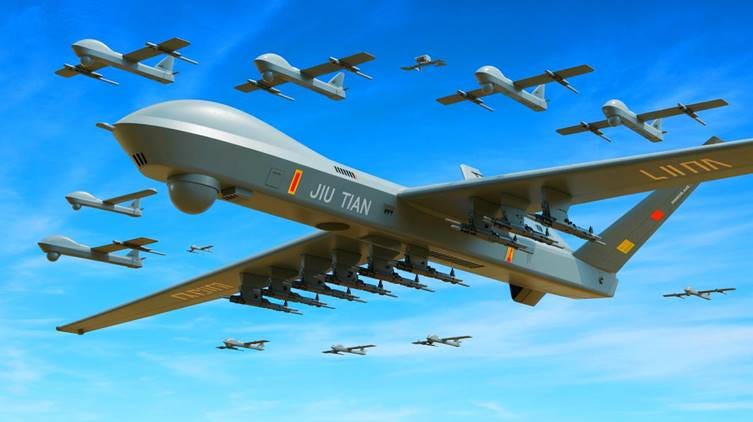
The surprise Ukrainian attack on Russia strategic airfields caused quite a bit social media discussions in China. Two take-aways stand out –
For readers interested in Chinese military drones, you can refer to my many articles on the subject.
WZ-9 drone – China’s “sensor truck” in the air
August 8, 2025
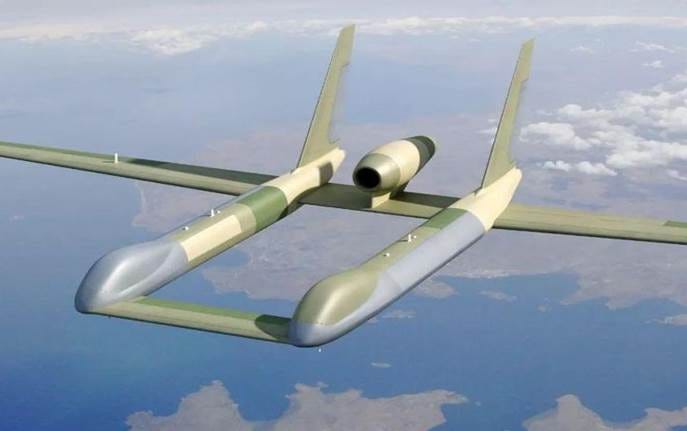
When the B-2 stealth bombers attacked Iran’s nuclear facilities in June, Trump regime showed the world that countries are vulnerable without air defense systems that can detect and destroy advanced stealth platforms.
CH-7 stealth ISR and precision strike drone
August 19, 2025
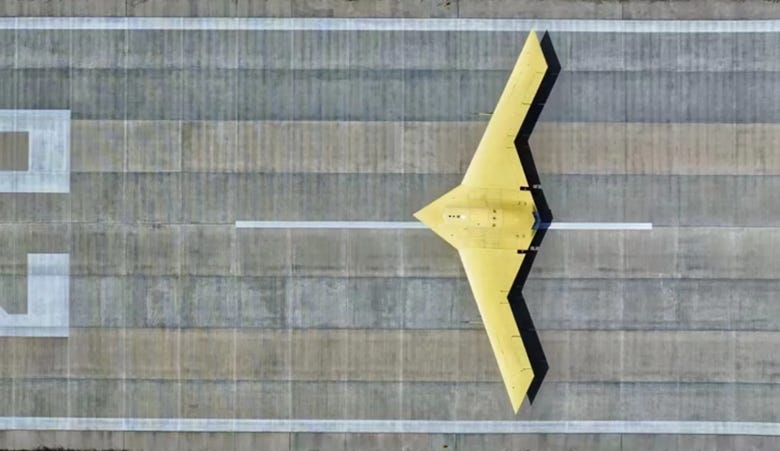
photo of WZ-7
WZ-8 near-space hypersonic stealth penetration drone
August 11, 2025
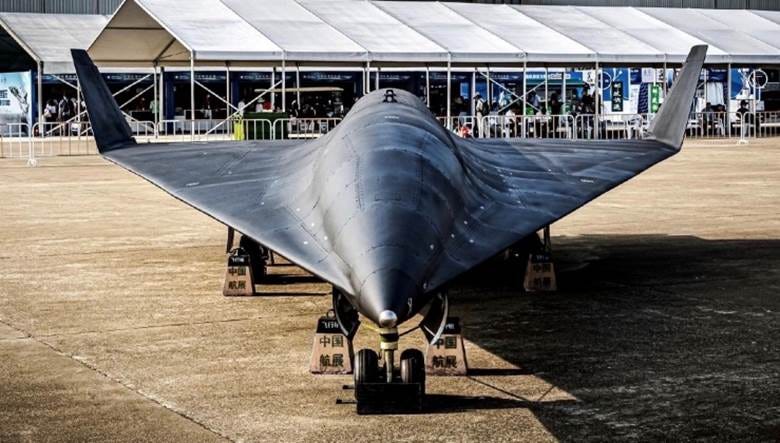
A critical element of modern warfare is system redundancy. As adversaries wage an endless loop of offense and defense innovations, no single weapon system can be relied upon to perform a designated task.
Let’s use the very basic ASN-301 drone for illustration.
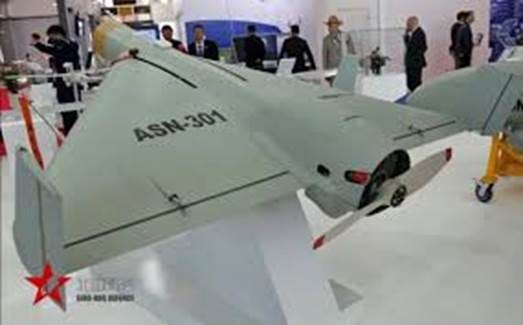
The ASN-301, developed by China’s Northwestern Polytechnical University, is a low-tier low-cost no-frills drone that works as a loitering munition and capable of AI-powered swarm attacks.
The ANS-301 shares the Shahed-136’s distinctive silhouette: a low-aspect-ratio, tailless delta wing, a cylindrical fuselage, a spherical optoelectronic nose, and a rear-mounted pusher propeller.
While the Shahed-136 is essentially a GPS-guided flying bomb targeting fixed locations, the ASN-301 is a sophisticated anti-radiation loitering munition designed to seek and destroy radar systems.
Iran’s Shahed-136 follows pre-programmed coordinates and detonates on impact. While inexpensive and mass-producible, it cannot adapt to moving or newly activated targets.
The ASN-301 can do all above. It is equipped with a passive anti-radiation seeker tuned to broad radar frequencies. It can autonomously detect, track, and destroy active radar emitters.
Its warhead features a laser proximity fuse that disperses about 7,000 preformed metal fragments on detonation, specifically optimized to damage radar antennas, dish arrays, and control systems rather than cause blunt-force damage.
The ASN-301 can be launched from truck-mounted canister systems, with multiple drones firing simultaneously from one vehicle, or from warships, providing both land and naval deployment flexibility.
Its ability to loiter over a target and strike only when radar activates makes it a suppression of enemy air defense (SEAD) weapon, a role traditionally held by costly standoff missiles like the AGM-88 HARM used by the USAF.
Rather than a standalone weapon as Shahed-136, dozens of ANS-301 and Feilong-300D can turn into a single, coordinated “pack” through the “Atlas Swarm System”, the software brain that powers what the Chinese defense circles describe as part of the “Intelligentized Warfare” strategy.
Instead of one pilot controlling one drone, the Atlas system allows hundreds of units to talk to each other and make decisions in real-time without human input.
The system moves away from traditional “remote control” and toward autonomous collaboration:
- Distributed Processing: There is no “mother drone.” If the lead drone is shot down, the remaining drones automatically recalculate and assign a new leader.
- Dynamic Tasking: If a swarm of 50 drones detects a carrier’s radar, the Atlas system might command 10 drones to act as decoys, 20 to jam communications, and 20 to dive in for the strike—all happening in seconds.
- Target Allocation: To avoid “overkill” (where 10 missiles hit the same small boat while ignoring a larger threat), the system ensures each drone identifies and hits a unique target within the group.
A carrier like the USS Abraham Lincoln is designed to track and kill sophisticated, fast-moving targets like supersonic missiles. However, the Atlas system exploits a “math problem”:
1. Magazine Depth: The Lincoln carries a limited number of ESSM and Rolling Airframe Missiles (RAM). If a swarm consists of 200 cheap drones, the carrier simply runs out of defensive missiles before the swarm is gone.
2. Radar Saturation: Even the advanced SPY-1 or SPY-6 radars can struggle to distinguish between 100 small drones and “clutter” (like birds or waves), especially when the drones are intentionally flying at different altitudes and speeds.
3. Cost Asymmetry: Launching a $2 million interceptor missile to kill a $10,000 drone is a losing financial battle.
This is where the idiom “Quantity has a quality of its own” becomes a reality. By using the Atlas system, China can turn a “quantity” of cheap, massed hardware into a “quality” high-tech threat that can paralyze a billion-dollar strike group.
Another example of how China has leapfrogged US air combat technology is the 5th generation fighters – the J-20 Mighty Dragon and the J-35 Gyrfalcon.
The F-22 Raptor is the most advanced 5th generation stealth fighter in the US arsenal. It is a twin-engine heavy-duty “air superiority” fighter considered the “tip of the spear” of US air combat.
It was developed in the 1980s and first entered service in 1997. Production was halted in 2011 after only 187 aircraft were built, far fewer than the original plan of 750, due to high costs and a shift in focus toward the F-35 and counter-insurgency wars.
Despite its superior stealth, super cruise, and “dog fight” manoeuvrability, the F-22 is one generation behind equivalent Chinese 5th-gen fighter – the J-20 Mighty Dragon – in radar technology and beyond-visual-range air-to-air missiles.
The F-22 uses gallium arsenide (GaAs) AESA radar and carries the AIM-120D air-to-air missile (160 to 180 km) vs. J-20’s gallium nitride (GaN) AESA radar and PL-15 missile (200 to 250 km).
In a “first see, first shoot” modern air combat, the J-20 can “see and shoot” earlier and from a greater distance than the F-22.
Some might argue the F-35 Lightening II is the latest and greatest in the US arsenal. That is a complete misperception.
The F-35 is a single-engine light “multi-role” fighter, a jack-of-all-trades. Despite the astronomical price tag, the fighter suffers from lower speed, shorter range, and less firepower.
F-35 top speed is Mach 1.6 vs. J-20’s Mach 2 to 2.5. F-35 combat radius is 1,200 to 1,400 km vs. J-20’s 2,000 to 2,200 km.
F-35 service ceiling is around 50,000 ft. vs. J-20’s 66,000 ft. F-35A payload capacity is roughly 8,200 kg vs. J-20’s 12,700 kg.
The F-35 is a lower-class weapon to the J-20 by all specs and mission profile.
The F-35’s Chinese counterpart is the J-35 Gyrfalcon, which is also deployed on Chinese carrier fleet.
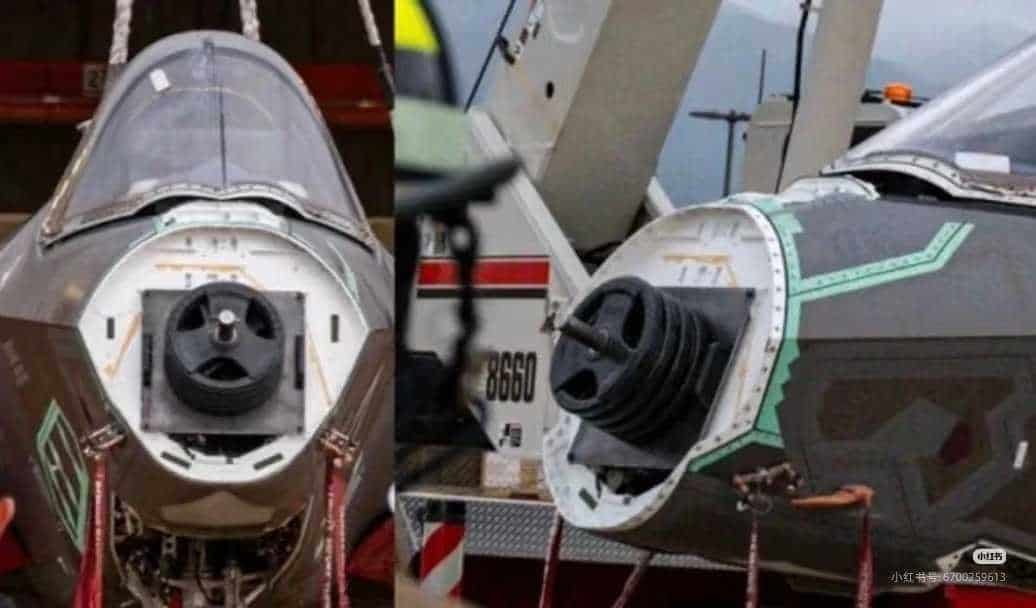
As I wrote in an earlier article, the most recent blocks of F-35s from Lot 17 features “gym weight” rather than radar in its nose cone since the upgraded radar from Northrop won’t be ready until Lot 20 in 2028.
The radar-less F-35s are essentially “blind” birds, flyable but mission-incapable.
In ten years, the US won’t even pretend it can go to war with China
Feb 26
I have written many times why China will prevail in any kinetic war with the US and its vassals near Chinese shores.
Even the 2028 timeline is highly uncertain since China has banned gallium export to the US that is needed for F-35’s upgrade to GaN AESA radar – the very reason for its current “blindness” predicament.
China has 100% market share of the 5N-level refined gallium needed for gallium-nitride semiconductor production (99.999% purity).
In 2024, China announced an export ban on gallium, germanium, and tungsten, all critical minerals for defense production.
China has not just caught up with the US with the 5th generation fighter program but also has taken an early lead to develop the 6th generation fighters.
Two Chinese 6th-gen fighter prototypes (J-36 and J-50, also known as J-XD) took to the sky since December 2024 and multiple variants of each model have flown since, showing a breakneck development pace.
Operational deployment is expected around 2030. Check out my post on J-36. https://huabinoliver.substack.com/p/chinas-j-36-six-generation-fighter
In contrast, the US 6th gen NGAD concept fighter F-47 won’t have a prototype ready for flight until 2028 at the earliest.
China is poised to field the 6th generation fighters 5 to 8 years ahead of the US.
In short, the US has no edge over China in air superiority from a technical perspective today and will only fall further behind in the coming years.
China’s advantage in missile technology is even greater than its UAV drone and manned fighter technology.
China is the undisputed world leader in hypersonic missiles of all ranges and propulsion technologies from hypersonic glide vehicle (HGV) to scramjet engine.
This diverse and mature hypersonic missile arsenal includes land, sea, and air-launched systems.
1. Land-Based Systems
- DF-17 (Medium-Range): The first and most famous of China’s hypersonic fleet, it utilizes a DF-ZF Hypersonic Glide Vehicle (HGV). It travels between Mach 5 and Mach 10, is road-mobile, and has an estimated range of 1,800–2,500 km
- DF-27 (Intermediate-Range): Often called a “strategic glide vehicle,” it is a longer-range system with an estimated reach of 5,000–8,000 km, capable of striking targets as far as Hawaii or the continental US
- DF-21D & DF-26: primarily classified as anti-ship ballistic missiles, their maneuverable reentry vehicles (MaRVs) can achieve hypersonic speeds over Mach 10 during their terminal phase
2. Sea-Based Systems
- YJ-21 (Eagle Strike 21): A “carrier-killer” hypersonic missile integrated into the universal vertical launch system of the Type 055 destroyers. It cruises at Mach 6 and accelerates to Mach 10 in its terminal dive
- YJ-20: highly compact hypersonic anti-ship missile specifically designed for the VLS cells of Type 052D and Type 055 destroyers
3. Air-Launched Systems
- KD-21 (Air-launched YJ-21): An air-launched variant carried by the H-6K bomber. Mach 10 terminal speed and max range 3,000 km.
4. Advanced “Scramjet” & Experimental Systems
Unlike the “boost-glide” missiles above, these use air-breathing engines to sustain hypersonic flight.
- YJ-19 & CJ-1000: Debuted in 2025, these are scramjet-powered cruise missiles that fly at lower altitudes (20–30 km), making them harder for radar to detect.CJ-1000 travels at Mach 6 and has a max range of 6,000 km. It can hit moving targets on land, sea, and air, including enemy AWACS and refueling tankers operating a long distance from the frontline
- Starry Sky-2 (Xingkong-2): A Mach 6 experimental hypersonic “waverider” design first tested in 2018, intended to use its own shockwaves for lift
Earlier in the article, I discussed the YKJ-1000 hypersonic missile, which is an example of ultra low-cost mass-produced high-tech weaponry made with civilian-grade components.
If you are interested in hypersonic missiles, I wrote a piece last year on two unique scramjet-powered hypersonic weapons unveiled in last September’s Beijing Military Parade – the CJ-1000 and the YJ-19. Read here https://huabinoliver.substack.com/p/meet-chinas-two-scramjet-powered
On the other hand, the US lags far behind China, Russia, North Korea, or Iran in developing the hypersonic missile program. It has yet to deploy any at scale and its hypersonic missile tests have suffered multiple setbacks.
https://defencesecurityasia.com/en/us-hypersonic-crisis-12-billion-zero-missiles-dark-eagle/
In Ukraine, the HIMARS was touted as a “wonder weapon” for a while. Let’s compare this multiple launch rocket system (MLRS) with its Chinese counterpart – the PCL-191.
The PCL-191 (also known as the PHL-16) is the world’s longest-ranged rocket artillery system, capable of striking targets at distances up to 750 km.
The system carries a variety of modular ammunitions:
- 300mm Rockets: short-range engagement between 70 and 150 km
- 370mm Guided Rockets: range of 280 to 350 km. Each vehicle can carry eight of these rockets, which are expected to serve as the main precision strike force in a Taiwan conflict
- 750mm Tactical Ballistic Missiles: Known as the Fire Dragon 480, these extend the system’s reach to 500 to 750 km
The PCL-191’s range significantly outdistances HIMARS, which has a max range of about 300 km with ATACMS missiles.
The very latest PrSM missile has a max range of 500 km. The US has used the entire PrSM stockpile in the first 3 weeks of the Iran war.
PCL-191 can reach any point on Taiwan from the Chinese mainland and deliver saturation bombing with high mobility (the road-mobile launcher can travel at 80 km/h) and low cost (1/3 cost of missiles of similar range).
In naval power, the US has a much bigger carrier fleet than China (11 vs. 3). The difference reflects the different mission profile of carrier strike groups of their navies.
The US focuses on “global power projection” while China purpose-builds its fleet for maritime defense and area denial around its littoral waters.
The latest Chinese carrier, Fujian, has already reached technological parity with the USS Gerald Ford. Both uses the most advanced electromagnetic aircraft launch system (EMALS).
Fujian’s DC-based EMALS is superior to Ford’s AC-based EMALS which suffers well-documented low reliability, energy storage and power faults.
The primary technical difference between the two carriers is their electrical system architecture: the Fujian uses a Direct Current (DC) system, while the USS Gerald R. Ford uses an Alternating Current (AC) system.
Fujian’s medium-voltage direct current (MVDC), developed by Ma Weiming, the legendary naval engineer and the youngest academician of the Chinese Academy of Engineering at 41, eliminates the need for complex transformer and rectifier systems used in AC grids.
DC systems are inherently more resilient to power fluctuations and disruptions, which is crucial for the high-surge power needs of an electromagnetic launch.
Fujian’s EMALS has a failure rate below 0.1% (one failure in 1,000 launches), significantly more reliable than the Ford’s AC-based system, which fails as often as every 181 to 272 launches.
To this day, the Ford carrier still cannot integrate F-35C, the main US Navy stealth fighter, to its air wing while the J-35 Gyrfalcon (counterpart to F-35C) is in service on Fujian already.
The nuclear submarine force of the US Navy still has a quantitative lead over China, but China has made critical breakthroughs in submarine detection technology with superconducting gravity detectors, challenging the survivability of US submarine fleet. Read here about the technology.
https://interestingengineering.com/military/chinas-sensor-detect-hidden-us-nuclear-submarines
https://johnmenadue.com/post/2026/04/new-detection-tech-could-make-aukus-submarines-obsolete/
The space domain has become a central focus for great power military competition.
China’s Beidou satellite navigation system has leaped ahead of the GPS system in global coverage, accuracy, and anti-jamming – a fact openly acknowledged by US military leaders.
A comparison of Beidou vs. GPS is instructive of the technological leap-forward China has made in the past 2 decades over US legacy systems.
The GPS system was first launched in the 1970s and the Beidou constellation in the early 2000s.
BeiDou operates a significantly larger satellite constellation of 56 satellites than the US GPS system with 31 satellites.
Beidou is also supported by 120 ground monitoring stations around the world, more than 10 times GPS.
Beidou allows for higher signal availability and better accuracy as a result. Beidou positioning accuracy for public/civilian use is under 1 meter vs. GPS’s 3-5 meters. Military/encrypted use accuracy is 1 centimeter vs. “centimeter level”.
Beidou also supports 2-way communication while GPS is one way.
Like the weapons used in the Iran battlefield, many GPS satellites are older generation legacy systems.
While all global navigation satellite systems (GNSS) are vulnerable to “jamming” and “spoofing” because all GNSS signals are extremely weak by the time they reach Earth’s surface, GPS is more prone to these threats in practice, especially for military or high-stakes applications.
GPS relies heavily on its legacy civilian signals. Its dated code is easy to jam or spoof. Even modern military GPS uses signals that lack the advanced modulation of newer systems.
Jamming GPS often succeeds with cheap, low-power devices because receivers lock onto the familiar, vulnerable codes first.
The US has been slower to fully deploy next-gen hardened features across the fleet (though GPS III satellites improve this with better M-code for military users). Older satellites and widespread legacy receivers remain weak points.
The upgrade to GPS III, which aims to match newer standards by mid 2030s, is already encountering setbacks. Read here
Despite investment of billions, the US has failed after a decade’s work in the upgrade of the ground systems for GPS and terminated the Next Generation Operation Control System (OCX).
https://spacenews.com/pentagon-officially-ends-ocx-program-citing-risk-and-delays/
On the other hand, Beidou-3 (the global version, operational since ~2020) was designed later, incorporating lessons from GPS vulnerabilities and modern signal-processing tech.
Beidou deploys advanced signal structures and modulation such as MBOC (multiplexed BOC), AltBOC, and ACE-BOC.
These provide better spectral separation, higher chipping rates, and improved resistance to interference/multipath compared to legacy GPS.
Beidou mixes medium-earth-orbit (MEO), plus GEO and IGSO satellites. This provides better regional coverage (especially over Asia and Africa) and improves redundancy against partial jamming.
Beidou is further integrated with terrestrial backups (fiber timing, long-wave systems, ground stations), reducing sole reliance on space signals.
This layered PNT (positioning, navigation, timing) makes the overall system more robust in contested environments.
Beidou is built with emphasis on anti-jam/anti-spoof from the start (e.g. better ranging accuracy, anti-multipath).
In reported conflicts, systems using Beidou reportedly maintained higher reliability (~98%) under jamming that crippled GPS (~70% failure).
After disabling GPS and switching to Beidou after the 12-day war, Iran has vastly improved its targeting accuracy against the US and Israeli targets in the current war.
This is proven by the destruction of numerous high-value targets despite the enemy’s superior electronic warfare capabilities.
You can check out how Iran has fared with Beidou against Israeli jamming in this Defence Security Asia report.
Beyond Beidou, China’s advanced geosynchronous orbit (GEO) satellites provide a permanent and continuous surveillance of hostile military assets.
With just three such satellites positioned strategically, 35,800 km overhead, China could achieve global, 24/7, all-weather reconnaissance coverage of high-value targets, including US carrier strike groups.
Beijing recently released a series of radar images from one GEO satellite that demonstrated the continuous tracking of a cargo ship in the South China Sea over days.
It marked the first time ever that a GEO synthetic aperture radar (SAR) had achieved long-term tracking of a moving maritime target.
This breakthrough gives Beijing continuous surveillance of US naval fleets across every ocean.
Unlike low-orbit satellites that pass over a location for only minutes at a time, this geosynchronous radar platform maintains a persistent watch despite cloud cover, darkness, and severe ocean interference.
Scientists at Tsinghua University revealed a new data processing architecture that could isolate weak ship echoes from violent sea clutter at distances previously considered physically impractical.
To match this capability using conventional low-orbit systems, other countries need to deploy hundreds or even thousands of lower earth orbit (LEO) satellites.
LEO satellites, such as the Starlink constellation and current US military radar satellites, operate 160 to 2,000 km above earth.
As a result, they are susceptible to jamming and destruction by ground-based electromagnetic or anti-satellite (ASAT) kinetic weapons during wartime.
On the other hand, satellites operating at GEO level (~35,786 km above earth) cannot be reached by current weapons.
Any American carrier strike groups approaching Taiwan or the South China Sea can now be detected, tracked, and targeted far earlier than previously assumed.
The US Navy has long relied on weather, distance, and the predictable gaps between low-orbit reconnaissance satellites to conceal operational movements.
For Pentagon planners, the GEO SAR satellite’s presence means a new battlespace in which concealment at sea no longer exists.
You can read more about this technology here. https://defencesecurityasia.com/en/china-three-satellites-track-us-warships-pentagon-end-of-naval-stealth/
Through breakthroughs in hypersonic missiles, drones, sixth-generation fighters, submarine detection quantum technology, and space technologies, China has secured a generational lead in multiple critical military domains.
In a future article, I will discuss the foundation such breakthroughs are based upon. A multi-year study carried out by Australia-based think tank, ASPI, has tracked the global research rankings of 74 critical technologies, including multiple military techs.
According to the past few years’ reports, China not only leads in the cutting-edge research with most of the technologies in the tracker but has widened its lead.
The 2026 ASPI report concludes that China now leads the research in 69 out of the 74 critical technologies tracked.
China’s investment in foundational scientific and technological fields is the basis for its breakneck military advancement. You can read the report summary here https://www.aspi.org.au/programs/critical-technology-tracker/
Most people, especially in the West, still blindly believe the US has superior weapons against its adversaries.
They certainly have seen US weapons in action a lot more than Chinese ones because China views war as a last resort, unlike the trigger-happy “bully of the world”.
I find a comparison of the two countries’ war machines analogous to the battle between ICE cars and EVs.
Most people simplistically frame ICE vs. EV as “power vs. environment”. Few are aware EVs have far more powerful acceleration (faster 0 to 100) and high energy efficiency (85-90% vs. 20-30%).
They are physically sturdier than ICE cars (~20 moving parts vs. ~2,000), and produce next to no noise, let alone less pollutants.
Few are aware EVs cost 50% less to maintain over their lifetime by eliminating costs like oil changes, spark plugs, and exhaust repair. The running cost is 1/3 with electric charging vs. petrol.
Modern batteries from CATL and BYD is designed to last 15 to 20 years (or up to 500,000–600,000 kilometers), far exceeding the usable lifespan of a petrol engine.
A comparison of software and in-car entertainment between EV and ICE cars is simply unfair.
Still a lot of people believe, intuitively and out of habit, that ICE cars are more reliable and perform better than EVs.
People who still believe in the superiority of the US military suffer from the same “cognitive dissonance” as those who believe the superiority of the ICE car simply because it is long tested and familiar.
But for those who have a deep understanding of modern military technology as well as industrial capacity and supply chain resilience, they know that the US has no advantages over China in a major war. And with time, the gap is getting wider.
The Iran war has already proven the US military underwhelms.
I can imagine the war planners in Pentagon having similar mixed feelings about the real Chinese military capabilities as Jim Farley, the CEO of Ford Motors, about Chinese EVs. They know which side is better, but they cannot acknowledge defeat.
Farley openly talks about a “humbling” gap in tech and cost between western carmakers and Chinese rivals like BYD. He drives a Xiaomi SU7 and described it as “fantastic” and said he “didn’t want to give it up”.
Farley characterizes Chinese EVs as far superior to western models, specifically highlighting the digital integration.
However, he also repeatedly called the Chinese auto industry an “existential threat” to Ford and the US economy.
In April 2026, Farley argued allowing Chinese EVs into the US would be “devastating” for American manufacturing.
He contends it is “not a fair fight” to allow Chinese carmakers to sell high-tech cars at prices western companies cannot match.
In order for the US carmakers to “win”, they must prevent Chinese EVs from entering the market. That is, winning by not competing.
This is how the US-China military contest will unfold as well – to hide the fact the US cannot win, their best option is not to have a fight.
The emperor is wearing no clothes.